

Introduction
Grading a 50-question test should be fast, clear, and stress-free. Whether you are a teacher checking papers, a student reviewing practice results, or a parent trying to understand a score, an easy grader helps turn correct and wrong answers into a percentage within seconds. Since every question on a 50-question test is worth 2%, you can calculate grades quickly without confusing math.
This updated 2026 guide explains the 50-question grading scale in simple English. You will learn how to calculate scores, use a quick grade chart, understand letter grades, and avoid common grading mistakes. It is designed for teachers and students who want accurate results, fair scoring, and an easier way to track test performance.
What Is a 50-Question Grading Scale?
A 50-question grading scale helps you convert test answers into a percentage. Since the test has 50 total questions, each question is worth 2%.
For example:
- 50 correct = 100%
- 45 correct = 90%
- 40 correct = 80%
- 35 correct = 70%
- 30 correct = 60%
This speeds up grading because you do not need a calculator every time. You can simply count how many answers are wrong and subtract 2% from each incorrect answer.
This method is useful for:
- School quizzes
- Practice tests
- Spelling tests
- Multiple-choice exams
- Homework checks
- Classroom worksheets
A grading scale also helps students understand their marks better. Instead of only seeing a number, they can see what their score means.
How to Calculate a Grade
The formula is simple:
Correct responses ÷ total questions × 100 equals %
For a 50-question test:
Correct answers ÷ 50 × 100 = grade percentage
Example:
A student gets 44 correct answers.
44 ÷ 50 = 0.88
0.88 × 100 = 88%
So, 44 out of 50 equals 88%.
You can also calculate the score by counting wrong answers:
100 – wrong answers × 2 = percentage
Example:
A student gets 6 wrong answers.
6 × 2 = 12
100 – 12 = 88%
So, 6 wrong answers also means the score is 88%.
This is why a 50-question test is simple to grade. Every question changes the score by exactly 2%.
50-Question Grade Chart
Use this table to verify grades quickly. Please count the incorrect answers and then calculate the percentage.
| Wrong Answers | Correct Answers | Score |
| 0 | 50 | 100% |
| 1 | 49 | 98% |
| 2 | 48 | 96% |
| 3 | 47 | 94% |
| 4 | 46 | 92% |
| 5 | 45 | 90% |
| 6 | 44 | 88% |
| 7 | 43 | 86% |
| 8 | 42 | 84% |
| 9 | 41 | 82% |
| 10 | 40 | 80% |
| 11 | 39 | 78% |
| 12 | 38 | 76% |
| 13 | 37 | 74% |
| 14 | 36 | 72% |
| 15 | 35 | 70% |
| 16 | 34 | 68% |
| 17 | 33 | 66% |
| 18 | 32 | 64% |
| 19 | 31 | 62% |
| 20 | 30 | 60% |
| 21 | 29 | 58% |
| 22 | 28 | 56% |
| 23 | 27 | 54% |
| 24 | 26 | 52% |
| 25 | 25 | 50% |
If more than 25 answers are wrong, the score falls below 50%. For most schools, that is usually a failing grade.
Letter Grade Scale
Different schools may use different letter grade systems. Always follow your teacher’s or school’s official grading policy. Here is a common example:
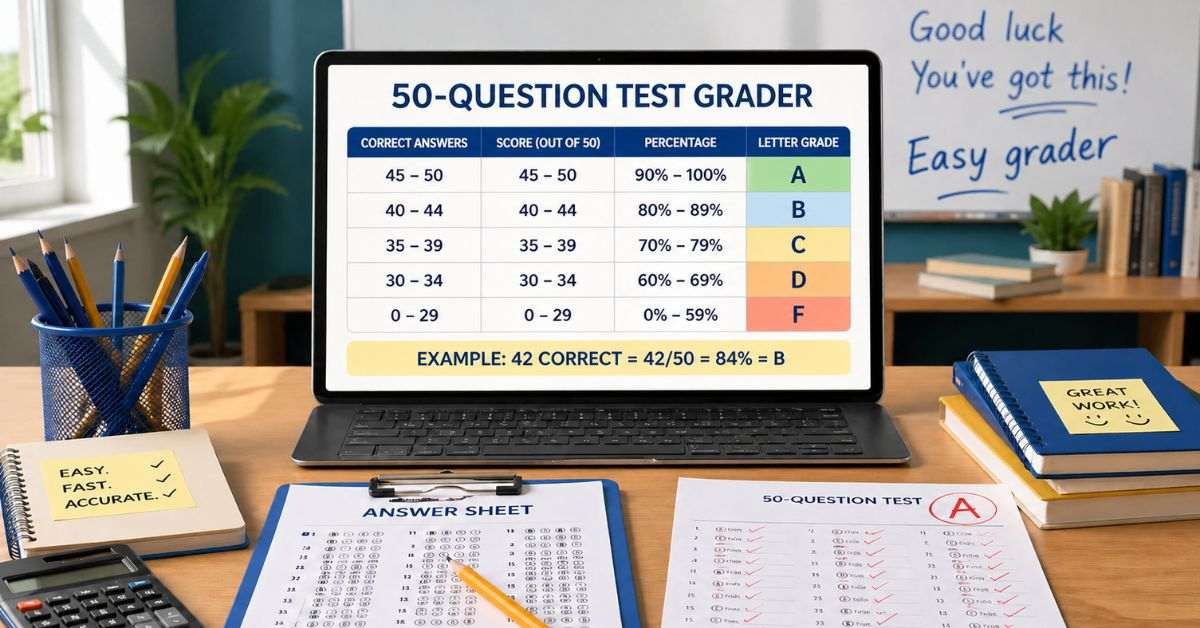
| Percentage | Letter Grade | Meaning |
| 90–100% | A | Excellent work |
| 80–89% | B | Good work |
| 70–79% | C | Average or basic understanding |
| 60–69% | D | Needs improvement |
| Below 60% | F | Not passing |
For example, if a student receives 45 out of 50, the score is 90%. That usually equals an A. If a student receives 40 out of 50, the score is 80%, which is usually a B.
Remember, letter grades are only one part of learning. A student should also know which questions they missed and what they need to review.
Correct Answers vs Wrong Answers
There are two easy ways to grade a 50-question test. The first way is to count correct answers. This is helpful when you want to show students what they earned.
Example:
- 43 correct answers out of 50
- 43 ÷ 50 × 100 = 86%
- Grade: usually B
The second way is to count wrong answers. This is faster for teachers.
Example:
- 7 wrong answers
- 7 × 2 = 14
- 100 – 14 = 86%
- Grade: usually B
Both methods provide the same answer. Many teachers prefer counting wrong answers because it saves time. An uncomplicated grader chart is helpful because easy grader removes guesswork. You can check the final score without repeating the formula again and again.
Tips for Teachers

Teachers often grade many papers at once. A simple grade chart can save time and reduce mistakes. Here are useful tips:
- Keep a printed grade chart near your desk.
- Count wrong answers first if all questions have equal value.
- Double-verify papers with very high or very low scores.
- ensure bonus points are added correctly.
- Use the same answer key for every student.
- Provide short feedback when possible.
For example, instead of only writing “76%,” you can write: “Good effort. Review questions 8, 14, and 21.”
This helps students know what to study next. Teachers should also explain the grading system before the test. If students know how the score works, they feel more confident and less confused.
Tips for Students
Students should not see a grade as only a number. A test score shows what you understand and what you still need to practice. How to interpret your score is as follows:
- 90–100%: You understand the topic very well.
- 80–89%: You did well, but reviewed a few mistakes.
- 70–79%: You understand the basics but need more practice.
- 60–69%: You should ask for help and study again.
- If your score falls below 60%, it indicates that you need to systematically relearn the topic.
If you miss questions, do not only look at the final score. Look at the type of mistakes you made.
Ask yourself
- Did I misunderstand the question?
- Did I forget the rule or formula?
- Did I rush?
- Did I skip studying one topic?
- Did I make a small careless mistake?
This process turns a grade into a learning plan.
Common Mistakes to Avoid
A grading chart works best when every question has the same value. If some questions are worth more points, you need a points-based score instead. Avoid these common mistakes:
- Using a 50-question chart for a test that does not have 50 questions.
- Forgetting that each question is worth 2%.
- Ignoring partial credit.
- Adding bonus points in the wrong place.
- Using the wrong letter grade scale.
- Rounding scores unfairly.
For example, if a test has 40 multiple-choice questions and 10 short-answer questions worth 2 points each, the total is not really 50 points. In that case, use total points instead of total questions. A grade calculator, test score chart, or classroom scoring table is best for simple tests where every answer has the same value.
Why This Method Is Useful in 2026
In 2026, many classrooms will use online gradebooks, digital quizzes, and learning apps. Still, teachers and students often need a fast way to check scores by hand. This simple method is useful because it is.
- Fast
- Easy to understand
- Good for paper tests
- Helpful for students and parents
- Easy enough for pupils in middle and high school
- Useful when internet tools are not available
An uncomplicated grader is not only for teachers. Students can also use easy grader to check practice test results before an exam. For best results, use the chart with clear feedback. A score tells you what happened. Feedback tells you what to do next.
FAQs
What does a grade of 45 out of 50 mean?
45 out of 50 is 90%, which is usually an A.
How does an easy grader work for 50 questions?
For a 50-question test, an easy grader counts each question as 2%, so 5 wrong answers equals 90%.
What is an easy grader used for?
An easy grader is used to quickly calculate test scores by turning correct or wrong answers into a percentage grade.
How many wrong answers can I receive and still have an A?
Usually, 0–5 wrong answers can still be an A.
Can I use this chart for every test?
No. Use it only when the test has 50 questions with equal value.
Conclusion
A 50-question grading scale is simple because every question is worth 2%. If a student misses one question, the score drops by 2 points. The score is 90% if they fail five questions. This makes grading fast and straightforward. This guide showed how to calculate scores, use a grade chart, understand letter grades, and avoid common mistakes. Teachers can use easy grader to save time, and students can use it to understand their results better.
For the best learning experience, do not stop at the final score. Review mistakes, find weak areas, and make a small study plan. Save this easy grader chart and use it whenever you need to grade a 50-question test quickly and accurately.